How Much ABSD Will You Pay as a Property Investor in Singapore?
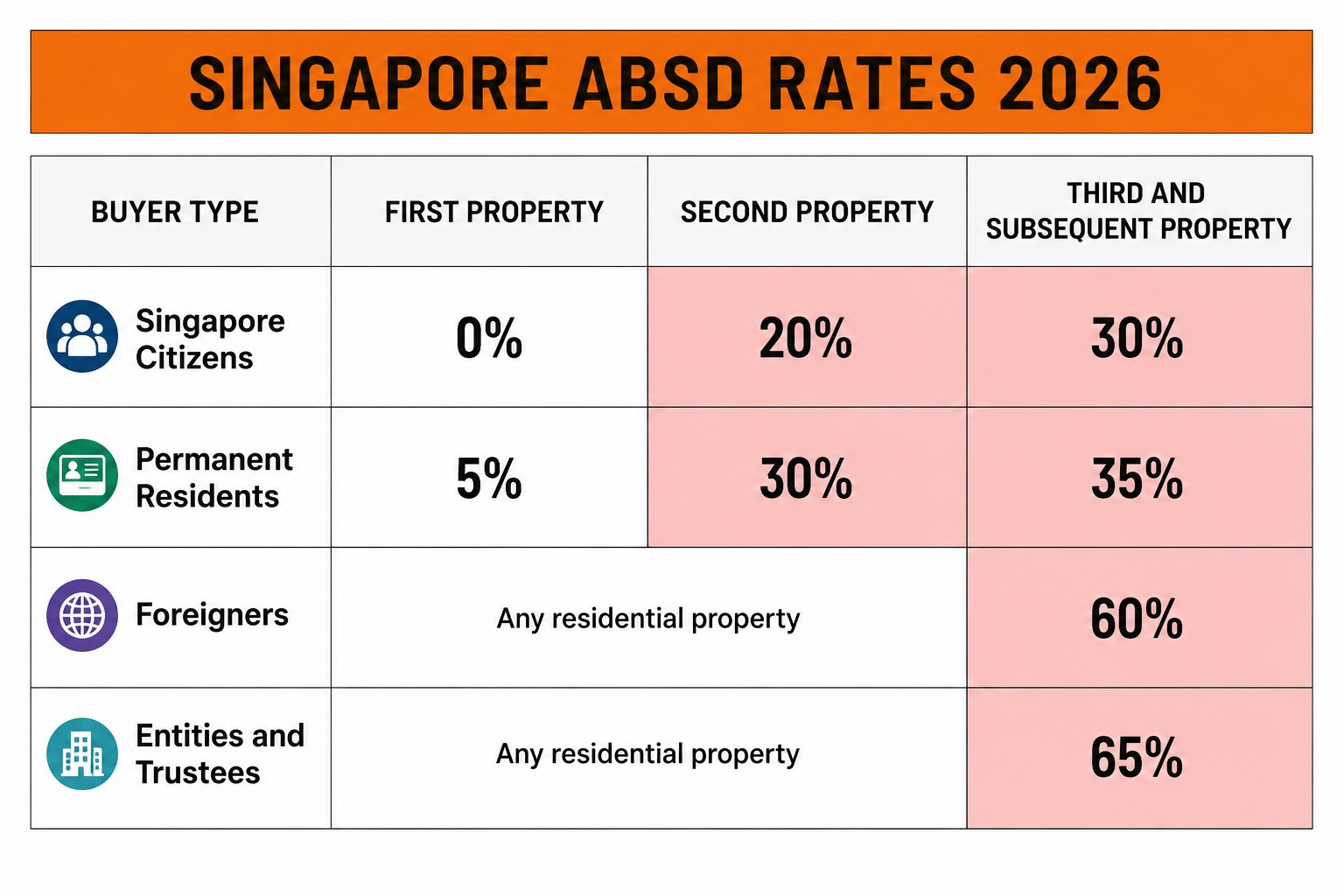
If you're trying to work out Singapore ABSD rates before your next property purchase, here's the short version. Singapore Citizens pay 0 percent on a first property, 20 percent on a second, and 30 percent on a third or beyond. Permanent Residents pay 5 percent, 30 percent, and 35 percent, respectively. Foreigners pay a flat 60 percent regardless of how many properties they already own.
That's a huge cost that can quietly wreck an investment's actual returns if you don't plan for it properly. So let's go through exactly how it's calculated, who pays what, and what you can legitimately do about it.
Singapore ABSD Rates 2026
These aren't estimates; they're the exact figures IRAS applies today. Everything below breaks down how each one is actually calculated and what you can legitimately do about it.
| Buyer Profile | 1st Property | 2nd Property | 3rd+ Property |
|---|---|---|---|
| Singapore Citizen | 0% | 20% | 30% |
| Permanent Resident | 5% | 30% | 35% |
| Foreigner | 60% | 60% | 60% |
| Entity or Company | 65% | 65% | 65% |
These figures have held steady since April 27, 2023, with no changes announced in Budget 2026. ABSD is paid on top of standard Buyer's Stamp Duty, not instead of it, and it's due within 14 days of exercising your Option to Purchase.
A Quick History: Why ABSD Rates Are What They Are Today
ABSD wasn't always this steep. It was introduced back in December 2011 as a cooling measure, aimed at slowing speculation and keeping Singapore Citizens from being priced out by foreign capital and investor demand.
Rates have climbed five separate times since then. The biggest jump came on April 27, 2023, when foreigner rates doubled overnight from 30 percent to 60 percent, and Citizen second-property rates rose from 17 percent to 20 percent. Understanding this history matters, since it shows ABSD isn't a fixed rule carved in stone; it's a policy lever the government adjusts based on market conditions, and it could move again if property demand heats up too fast.
BSD vs ABSD vs SSD: What's the Actual Difference
These three terms get confused constantly, so let's separate them clearly.
Buyer's Stamp Duty, or BSD, applies to every residential purchase in Singapore, on a progressive scale from 1 percent to 6 percent depending on the price tier. Additional Buyer's Stamp Duty, or ABSD, is the extra layer that applies based on your buyer profile and how many properties you already own. Seller's Stamp Duty, or SSD, only applies if you sell within a set holding period after buying, typically within three years for residential property.
Think of it this way. BSD applies to everyone, ABSD applies based on who you are and what you already own, and SSD applies only if you sell too soon. All three can apply to the same transaction depending on your situation.
How ABSD Is Actually Calculated
ABSD is calculated on the higher of your purchase price or the property's market valuation, not simply what you agreed to pay.
Here's what that means in practice. If you buy a unit for $1.5 million but IRAS values it at $1.6 million, your ABSD gets calculated on the $1.6 million figure, not your actual purchase price. This catches buyers off guard more often than you'd expect, especially in a rising market where valuations can outpace agreed sale prices.
ABSD by Buyer Profile, Full Breakdown
Numbers help more than percentages alone. Here's what Singapore ABSD rates actually look like in real dollars on a $1.5 million property, the kind of number we run through with clients at Colin Choo Property before any purchase decision gets made.
Singapore Citizen, second property: 20 percent ABSD equals $300,000, plus standard BSD of $44,600, for a total stamp duty of $344,600.
Permanent Resident, first property: 5 percent ABSD equals $75,000, plus BSD of $44,600, for a combined $119,600.
Foreigner, any property: 60 percent ABSD equals $900,000, plus BSD of $44,600, bringing total stamp duty to $944,600, nearly 63 percent of the purchase price going to tax alone.
Entity or company: 65 percent ABSD, the steepest rate of all, plus BSD, applies to companies, partnerships, and trusts acquiring residential property.
The FTA Exception Most Foreign Buyers Don't Know About
Not every foreigner pays the flat 60 percent rate, and this genuinely surprises a lot of buyers.
Nationals and permanent residents of Iceland, Liechtenstein, Norway, Switzerland, and the United States get Citizen-equivalent ABSD treatment, thanks to Free Trade Agreements Singapore has with these countries. If you hold citizenship from one of these five countries, your ABSD exposure looks completely different from what a typical foreign buyer would face, so it's worth confirming your eligibility before assuming the worst-case rate applies to you.
What ABSD Actually Does to Your Investment Return
This is where most guides stop short, and it's exactly where the real decision gets made. ABSD isn't just an upfront cost; it fundamentally changes your investment's actual return.
Take a foreign buyer purchasing a $1.5 million unit at a solid 3.8 percent gross rental yield. After paying $944,600 in total stamp duty and amortizing that cost over a 10-year hold, the net annual return can drop to roughly 1.2 percent, a figure that makes the investment case look completely different from the headline yield number. This is exactly why understanding regional yield ranges, CCR typically running 2.5 to 3.5 percent, RCR at 3.0 to 4.0 percent, OCR at 3.5 to 4.5 percent, matters just as much as the ABSD rate itself. A high-yield district can still underperform once ABSD gets factored into the real math.
If you haven't worked out which region actually fits your investment goal yet, our guide on Best Places to Invest in Property in Singapore breaks down CCR, RCR, and OCR in full detail.
Can You Get ABSD Refunded?
Yes, in specific circumstances. Singapore Citizens who pay 20 percent ABSD on a second property can get it fully refunded if they sell their first property within 6 months of the second purchase.
This matters enormously for anyone upgrading from an HDB flat to a condo. If you buy your new home before your HDB sale completes, you'll pay ABSD upfront, but selling within that 6-month window gets it back. Married couples buying their first joint matrimonial home may also qualify for remission under separate conditions, worth checking against your specific situation before assuming you don't qualify.
Joint Purchases: Why the Highest Rate Applies to Everyone
Here's a detail most guides skip entirely. When two or more buyers with different profiles purchase a property together, the highest applicable ABSD rate among all of them applies to the entire property value, not a blended average based on ownership share.
So if a Singapore Citizen buys jointly with a foreigner, the full 60 percent rate applies to the whole purchase, not just the foreigner's portion. This single rule has derailed more than a few joint purchase plans once buyers actually ran the numbers, so it's worth confirming everyone's individual profile before assuming a mixed purchase softens the tax hit.
When and How ABSD Actually Gets Paid
ABSD is due within 14 days of exercising your Option to Purchase, and it must be paid in cash; CPF cannot be used for this specific tax.
Miss that 14-day window, and penalties escalate quickly, starting at a flat fee or the duty amount, whichever is higher, and climbing the longer payment is delayed. This isn't a bill you want to accidentally miss; budget for it as a hard deadline, not a flexible one.
Legitimate Ways to Reduce Your ABSD Exposure
ABSD can't be avoided outright for a genuine second property purchase, but there are real, legal ways to structure around it.
Decoupling lets one co-owner transfer their share of an existing property to the other owner, allowing the exiting party to buy their next property as a first-time owner, paying 0 percent instead of 20 percent. Timing your HDB sale to complete before or alongside your new purchase's Option to Purchase can help you avoid the ABSD hit entirely rather than paying and waiting for a refund. Married couples buying their first joint home may also access remission under specific conditions.
None of these are loopholes; they're legitimate structuring options, but each carries real costs: legal fees, transfer stamp duty, and a fresh loan assessment, so they need proper calculation against your actual savings, not a general assumption that they'll help.
A Real Case: How ABSD Changed an Investment Decision
One investor came to Colin Choo Property set on a second condo purchase, planning to buy before selling an existing rental unit. Running the actual numbers, 20 percent ABSD on the new purchase, versus selling first and entering as effectively a first-time buyer again through the refund mechanism, changed the entire timeline of the deal.
He ended up selling his existing unit first, waited six weeks, then proceeded with the new purchase entirely ABSD-free. The delay cost him a small amount in missed rental income during the gap, but it saved him well over $250,000 in stamp duty. Sometimes the right move isn't the fastest one.
How Colin Choo Helps You Model ABSD Into Your Returns
ABSD isn't just a cost to budget for; it's a number that needs to be built directly into your yield calculations before you commit to any purchase.
At Colin Choo Property, Colin, a Property investment consultant in Singapore, walks investors through exactly this, modeling ABSD against expected rental yield and holding period before a single unit gets shortlisted. As a property investment agent in Singapore with 14 years and close to 1,000 transactions behind him, he treats this as a numbers-first conversation, since the wrong sequencing or profile assumption can cost hundreds of thousands of dollars, far more than any consultation would ever cost.
If you're weighing a second or third property purchase, or unsure whether decoupling or timing makes sense for your situation, that's exactly the kind of question worth working through before you sign anything.
Final Thoughts
Singapore ABSD rates aren't just a line item; they can fundamentally reshape whether a property investment actually makes financial sense. Know your buyer profile, calculate the real impact on your net yield, and explore legitimate structuring options before you commit, not after.
Want help modeling ABSD into your next investment decision? WhatsApp Colin Choo at Colin Choo Property for a straight, no-pressure conversation.
Free, No-Pressure Consultation
Not sure how much ABSD your purchase will trigger?
No obligation. No pitch. Just a straight read on your numbers.
WhatsApp Colin ChooFAQs
1. What are the current Singapore ABSD rates for 2026?+
Singapore Citizens pay 0 percent on a first property, 20 percent on a second, and 30 percent on a third or beyond. PRs pay 5 percent, 30 percent, and 35 percent. Foreigners pay a flat 60 percent on any purchase.
2. Is ABSD calculated on the purchase price or market value?+
Whichever is higher. If your agreed price is lower than the IRAS valuation, ABSD is calculated on the higher valuation figure, not your purchase price.
3. Can I get my ABSD back if I sell my other property?+
Yes, Singapore Citizens can get a full ABSD refund if they sell their first property within 6 months of completing a second property purchase.
4. Do all foreigners pay 60 percent ABSD in Singapore?+
No. Nationals and permanent residents of Iceland, Liechtenstein, Norway, Switzerland, and the United States receive Citizen-equivalent treatment under Free Trade Agreements.
5. How does ABSD affect rental yield for investors?+
Significantly. A high gross yield can drop dramatically once ABSD is amortized over your holding period, sometimes falling below 2 percent net for foreign buyers on high-ABSD purchases.
6. What happens if I miss the 14-day ABSD payment deadline?+
Penalties apply and escalate the longer payment is overdue, so treat the 14-day window as a hard deadline, not a flexible one.
7. Does decoupling actually help avoid ABSD?+
It can, by letting one owner exit and re-enter as a first-time buyer on their next purchase, but it carries real legal and financial costs that need to be weighed against the actual ABSD savings first.
Disclaimer
This guide is provided by Colin Choo, a property agent in Singapore and Associate District Director at PropNex Realty, CEA Registration R045976G. Rates and figures are accurate as of the publication date but may change with future policy updates. For guidance specific to your situation, contact Colin directly for a straight, no-pressure conversation.