Best Places to Invest in Property in Singapore
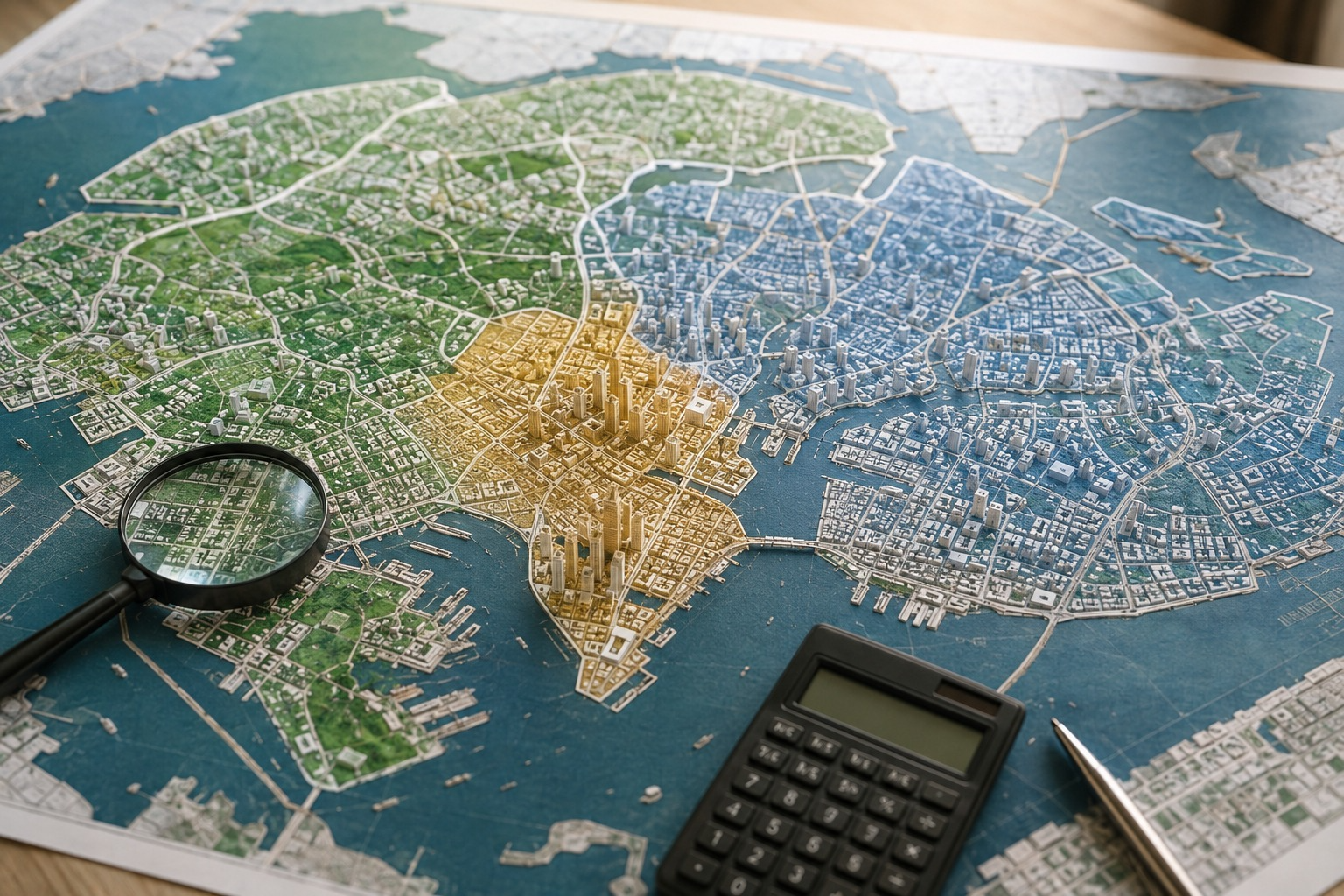
If you're searching for the best places to invest in property in Singapore, here's the honest starting point. There isn't one single best answer. There are three genuinely different paths, Core Central, City Fringe, and Suburban, and each one suits a different investor goal.
Most guides just hand you a ranked list of neighborhoods and stop there. That's not enough. The real question isn't which district wins on paper; it's which one actually fits what you're trying to achieve, monthly cash flow, long-term growth, or something in between.
This guide comes from Colin Choo, a property consultant in Singapore with 14 years and close to 1,000 transactions behind him, CEA Registration R045976G.
Why "Best" Depends on Your Goal, Not the District
Ask ten property agents where the best place to invest is, and you'll likely get ten different answers, because they're all answering a different underlying question.
Do you need the property to pay for itself every month through rent? Or are you comfortable with a lower monthly return in exchange for stronger long-term appreciation? These are two different goals, and they point to two different regions of Singapore.
At Colin Choo Property, this is always the first question before any district is discussed. Getting this wrong doesn't just mean a slightly lower return; it can mean years of holding an asset that never actually does what you needed it to do.
Best Place to Invest in Singapore: CCR, RCR, or OCR?
Singapore's private property market splits into three broad regions, and each behaves differently as an investment.
Core Central Region, or CCR, covers the most prestigious addresses, Orchard, Marina Bay, and Tanglin. The rest of the Central Region, or RCR, sits just outside that core, the city fringe. Outside Central Region, or OCR, covers the suburban heartlands, further from the center but closer to where most Singaporeans actually live and work.
Here's the pattern that holds true almost every cycle. The closer you are to the center, the lower your rental yield tends to be, but the stronger your historical capital appreciation. The further out you go, the higher your yield, but growth tends to be steadier rather than dramatic.
CCR, Capital Preservation and Prestige
Districts like Orchard, Marina Bay, and Tanglin sit in the CCR. Gross rental yields here typically range from 2.5 percent to 3.5 percent, the lowest of the three regions.
Why would anyone accept a lower yield? Because CCR has historically captured the deepest capital appreciation over long holding periods, and it attracts a buyer pool that includes wealthy locals, permanent residents, and foreign buyers willing to pay a premium for prestige and location. If your goal is preserving and growing capital over a ten-year hold rather than generating monthly income, this is the region built for that.
RCR, The Balanced Middle Ground
City fringe districts, think Queenstown, Novena, Toa Payoh, sit in the RCR. Yields here typically run 3.0 percent to 4.0 percent, a genuine middle ground.
This region draws strong tenant demand from working professionals who want proximity to the city without CCR pricing. It's often the region where investors who can't decide between yield and growth end up landing, since it offers a reasonable amount of both without fully committing to either extreme.
OCR, Where the Real Yield Lives
Suburban regions like Punggol, Woodlands, and Choa Chu Kang fall under OCR, and this is where gross yields climb highest, typically 3.5 percent to 4.5 percent.
The yield story here is tied directly to real employment growth, not just cheaper entry prices. Areas like Punggol Digital District, Woodlands Regional Centre, and Changi Business Park are actively expanding as job hubs, which pulls in genuine long-term tenant demand from workers who want to live close to where they work, not just commute in from far away.
The Singapore-wide average gross rental yield sits at roughly 3.5 percent in 2026, and OCR is where you're most likely to land above that average.
A Side-by-Side Comparison
Numbers side by side make the trade-off easier to see.
| Region | Gross Yield Range | Entry Price Level | Best Suited Goal |
|---|---|---|---|
| CCR (Orchard, Marina Bay, Tanglin) | 2.5% to 3.5% | Highest | Capital preservation, long-term growth |
| RCR (Queenstown, Novena, Toa Payoh) | 3.0% to 4.0% | Mid range | Balanced yield and growth |
| OCR (Punggol, Woodlands, Choa Chu Kang) | 3.5% to 4.5% | Lowest | Cash flow, rental income |
Remember, these are gross figures. Net yield lands meaningfully lower once maintenance fees, property tax, agent commission, income tax on rental, and vacancy periods between tenants get deducted. Always budget on net, not gross.
Financing Considerations by Region
Financing doesn't work the same across all three regions.
- CCR: larger loan amounts even at 75 percent LTV, banks scrutinize income more closely
- RCR: price points align with typical income brackets, generally the smoothest approval process
- OCR: most accessible entry point for first-time investors, though TDSR still caps at 55 percent regardless of region
One thing that catches people off guard, an existing home loan drops your LTV to 45 percent across all three regions equally. Financing doesn't get easier just because you pick a cheaper district.
ABSD: What Investors Can Legally Do About It
ABSD can't be avoided outright, but there are legitimate ways to structure around it. Decoupling, where one co-owner transfers their share of an existing property, lets the other buy the next one as a first-time owner, paying 0 percent ABSD instead of 20 percent, while married couples buying their first joint matrimonial home may qualify for a refund once any existing property sells within the required window. Neither is a loophole; both carry real costs, legal fees, transfer stamp duty, and a fresh loan assessment, so they need actual calculation, not assumption.
How Market Cycles Affect Each Region Differently
The three regions don't move together during a cycle. CCR tends to lead both the downturn and the recovery, since it's more sensitive to foreign and high net worth buyer sentiment, which pulls back first when confidence drops and flows back first once it returns.
OCR holds steadier through downturns, driven by local owner-occupier demand rather than sentiment swings, while RCR sits in between with some of both. This is part of why CCR suits patient capital, and OCR suits investors who want stability through a full cycle, not just in good years.
Beyond Region, What Actually Drives Value in Any District
Region alone doesn't guarantee a good investment. Within any of the three regions, a few specific factors consistently move the needle.
Proximity to an MRT station, particularly an interchange station, tends to command a real premium and holds value better during downturns. Nearby top-tier primary schools do something similar; families pay for that access regardless of which broader region the unit sits in.
There's a more technical factor too, worth understanding if you're thinking long term. Comparing a development's current Gross Floor Area against what Singapore's URA Master Plan actually permits on that land can reveal genuine redevelopment upside, the same underlying logic that drives en bloc potential. A unit sitting well below its permitted plot ratio carries upside that a fully built-out development simply doesn't have.
Common Mistakes When Chasing "Best" Districts
A few patterns show up repeatedly with investors who end up disappointed by their district choice.
- Chasing the highest yield number without checking that area's actual vacancy rate first
- Chasing capital growth in CCR without the holding period patience it genuinely requires
- Ignoring how ABSD changes the entire calculation, since a 20 percent charge on a second property can make certain price points unworkable regardless of yield
- Assuming a "best" district ranking from a generic article applies to their specific financial situation
Any one of these can turn what looked like a smart pick on paper into years of underperformance.
A Real Case, Two Investors, Two Different "Best" Answers
One investor came to Colin Choo Property wanting monthly rental income to supplement retirement. An OCR unit near Punggol Digital District made sense: strong yield, steady tenant demand from the growing job cluster nearby.
Another investor, still working with a longer time horizon, wanted the property to grow in value over ten to fifteen years rather than generate cash flow right away. A CCR unit fit that goal far better, even at a lower starting yield.
Both were the right "best place" for that specific person. Neither would have worked well for the other.
How Colin Choo Helps You Match District to Goal
Region names and yield ranges are a starting point, not the finish line. The real work is matching that data to your actual financial position and goal.
At Colin Choo Property, Colin, a property consultant in Singapore, walks through your ABSD exposure, financing headroom, and real objective, income or growth, before any specific district gets shortlisted. As a property investment agent in Singapore with 14 years and close to 1,000 transactions behind him, he treats this as a numbers-first conversation, not a sales pitch dressed up as advice.
If you're still unsure whether CCR, RCR, or OCR fits your situation, that's exactly the kind of question worth working through before you commit to a unit, not after.
Final Thoughts
There's no single best place to invest in property in Singapore, only the best place for your specific goal. CCR rewards patience and capital preservation, RCR offers balance, and OCR delivers the strongest cash flow. Knowing which one you actually need matters more than any ranked list.
Want help matching your goal to the right region? WhatsApp Colin Choo at Colin Choo Property for a straight, no-pressure conversation.
Free, No-Pressure Consultation
Not sure which region fits your goal?
No obligation. No pitch. Just a straight read on your numbers.
WhatsApp Colin ChooFAQs
1. What is the best region to invest in for rental yield in Singapore?+
OCR generally offers the highest gross rental yields, typically 3.5 percent to 4.5 percent, driven by strong tenant demand near growing job hubs like Punggol Digital District and Woodlands Regional Centre.
2. Which region has the strongest capital appreciation in Singapore?+
CCR has historically captured the deepest long-term capital appreciation, though it comes with the lowest rental yield of the three regions, typically 2.5 percent to 3.5 percent.
3. Is RCR a good compromise between CCR and OCR?+
Yes, RCR typically offers a balanced yield of 3.0 percent to 4.0 percent, along with strong tenant demand from professionals who want city proximity without CCR-level pricing.
4. Does ABSD change which district makes sense to invest in?+
Significantly. A 20 percent ABSD charge for Singapore Citizens on a second property, or higher for PRs and foreigners, can make certain price points unworkable, which effectively narrows which regions remain financially sensible.
5. How much does gross yield differ from net yield in Singapore?+
Net yield typically lands meaningfully lower than gross once maintenance fees, property tax, agent commission, income tax, and vacancy periods are deducted, so always budget using net figures.