SORA vs Fixed Home Loan Singapore 2026: Which Is Better?
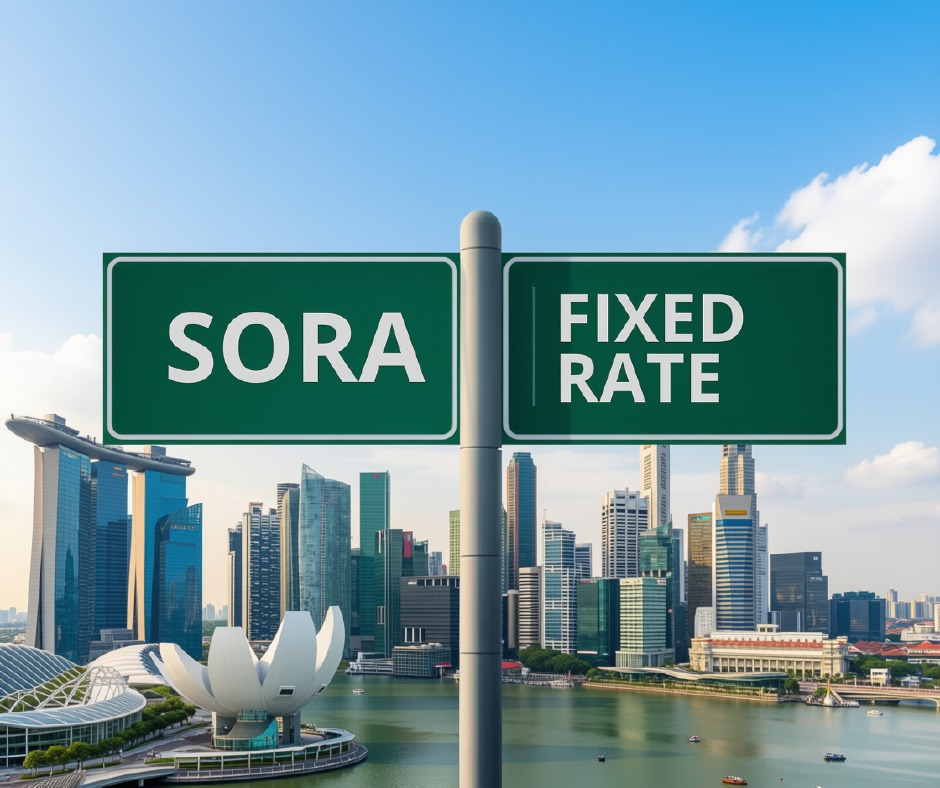
If you're weighing SORA vs fixed home loan Singapore options right now, here's the honest picture. SORA has dropped to near multi-year lows, sitting at 1.08% for the 1-month rate and 1.12% for the 3-month rate as of early August 2026. Fixed packages have followed it down too, with some banks offering 2-year fixed rates as low as 1.40%.
That's exactly what makes this decision genuinely hard right now, not obvious either way. A year ago, floating rates were clearly cheaper. Today the gap has narrowed so much that the old advice, just pick SORA when rates are falling, doesn't automatically apply anymore.
What Is SORA, and Why Did It Replace SIBOR?
SORA stands for the Singapore Overnight Rate Average. It's the volume-weighted average rate of unsecured overnight interbank lending, published daily by MAS.
SIBOR and SOR were phased out completely by the end of 2024. Every new floating rate home loan in Singapore now uses SORA as its benchmark, so if you're taking a new loan today, this is the number that actually shapes your monthly repayment.
Banks price loans as SORA plus a spread. So a package might read as 3M Compounded SORA plus 0.80%, and your effective rate is simply those two numbers added together.
SORA Rates Right Now: The Actual Numbers
As of early August 2026, 1-month Compounded SORA sits at 1.08%, and 3-month Compounded SORA sits at 1.12%. Both are close to multi-year lows, a sharp drop from levels above 3% seen in early 2025.
With a typical bank spread of 0.80%, a standard SORA-linked package works out to roughly 1.92% per annum today. That spread itself isn't fixed either; it typically ranges from 0.50% to 1.00%, depending on your loan size, income strength, and how competitively a particular bank is pricing loans that month.
Here's a number worth sitting with. A 10 to 25 basis point difference in spread alone can swing your monthly repayment by $80 to $210 on a $1 million loan. That's not a rounding error; that's real money over a 25- or 30-year tenure.
Fixed Rate Packages Right Now: The Actual Numbers
Fixed rates have come down alongside SORA, though they still typically carry a small premium for the certainty they offer. Some banks are currently offering 2-year fixed packages as low as 1.40%, with select promotional 1 plus 1 year fixed structures around 1.45%.
That's genuinely close to where floating rates sit today. A few years ago, fixed and floating rates could differ by a full percentage point or more. Right now, the gap has narrowed to a fraction of that.
SORA vs Fixed, Side by Side
Numbers help, but seeing them next to each other makes the trade-off clearer.
| Factor | SORA (Floating) | Fixed |
|---|---|---|
| Current typical rate | Around 1.92% (SORA plus spread) | From 1.40% to 1.45% |
| How it moves | Adjusts every 1 or 3 months with the market | Locked for the fixed period, usually 2 to 5 years |
| Best when | Rates are stable or falling | You want budget certainty or expect rates to rise |
| Risk | Payments can rise if SORA climbs again | You may miss out if rates keep falling |
| Lock-in penalties | Usually lower or none | Typically stricter, higher exit costs |
Neither option is universally better. It genuinely depends on your risk tolerance and how much certainty you personally need in your monthly budget.
At Colin Choo Property, this is usually the first real fork in the road when we talk financing with buyers. The SORA vs fixed home loan Singapore question rarely has one right answer; it comes down to your own numbers, not a general rule.
Why a Lower SORA Doesn't Automatically Mean You Can Borrow More
Here's something a lot of buyers get wrong. Even though actual rates have dropped, your loan eligibility isn't calculated using today's low SORA figure.
MAS requires banks to stress test your Total Debt Servicing Ratio using a much higher rate, typically around 4%, regardless of what you'd actually pay today. So your borrowing capacity stays roughly the same whether SORA sits at 1% or 3%, even though your actual monthly repayment would look very different.
This catches people off guard constantly. They assume a lower SORA means a bigger loan gets approved. It doesn't work that way, and any property consultant in Singapore worth talking to should flag this before you start house hunting based on today's low rates.
If you haven't worked out your actual borrowing capacity yet, our guide on how much money you need to buy a condo in Singapore breaks down the full downpayment and TDSR math in detail.
The Real Cost of Switching
Switching isn't free, whether you're moving from fixed to floating or the other way around.
Refinancing typically triggers a redemption penalty of around 1.5%, for example $7,500 on a $500,000 loan. Banks may also claw back promotional benefits like legal subsidies if you refinance within 2 to 3 years of taking the original loan.
There's a difference between repricing and refinancing too, and it's worth knowing before you make a call. Repricing means switching packages with your existing bank, usually cheaper and faster. Refinancing means moving to a completely different bank, which can offer better rates but comes with legal fees and a longer process.
A good property agent in Singapore will usually flag this distinction before you assume refinancing is automatically worth it. Sometimes it isn't, once the penalty and paperwork are factored in.
1-Month vs 3-Month SORA, Does It Matter Which You Pick?
Most buyers never think about this choice, but it does matter. The 1-month SORA reacts faster to market changes, while the 3-month SORA smooths things out over a longer window.
Here's the part that surprises people. You can't just switch from a 3-month peg to a 1-month peg because 1-month happens to be lower this particular month. Your loan is contractually tied to one tenor. Changing it means repricing or refinancing, both of which bring their own costs, so this isn't a decision to treat lightly.
Who Should Actually Choose SORA Right Now
Floating rates make sense if you believe rates will stay low or keep falling, and you're comfortable with some month-to-month movement in your repayment.
They also tend to fit newer purchases better. If you're still paying progressively on a building under construction, your loan balance starts small, so the volatility of a floating rate has less impact in the first year or two compared to someone with a fully disbursed loan.
Who Should Actually Choose Fixed Right Now
Fixed rates make sense if predictability matters more to you than chasing the lowest possible number. If a sudden rate spike would genuinely stress your household budget, that peace of mind has real value, even if it costs slightly more today.
Given how close fixed and floating rates have become recently, this is one of the few moments in years where choosing fixed doesn't mean paying a steep premium for that certainty.
A Real Case: When Switching Made Sense, and When It Didn't
One client refinanced from a 2.8% legacy fixed rate into a SORA-linked package earlier this year, and the savings were immediate, well over $300 a month on their loan size. That switch made sense because their old rate was genuinely high compared to what the market offered.
Another client, already on a low SORA package, considered switching to fixed purely out of nervousness about future rate hikes. After running the actual numbers, including the refinancing penalty, staying put made more sense. Not every rate worry justifies a switch; sometimes the cost of moving outweighs the benefit.
How a Property Consultant in Singapore Can Help
Rate comparisons look simple on a chart, but the right choice depends on your loan size, your risk tolerance, and how long you plan to hold the property.
At Colin Choo Property, Colin works alongside mortgage specialists to help buyers understand not just which rate is lowest today, but which structure actually fits their situation. As a property agent in Singapore who has guided buyers through financing decisions for 14 years, he has seen how both SORA and fixed choices play out over time, not just in the first year.
If you are unsure whether refinancing makes sense for your current loan, or which package fits a new purchase, that is exactly the kind of question worth asking before you sign anything.
Final Thoughts
Choosing between SORA and a fixed home loan in Singapore right now comes down to how much certainty you need versus how much you're willing to ride with the market. This SORA vs fixed home loan Singapore decision has no universally right answer with rates this close together, just the one that fits your actual risk tolerance and loan size.
Want a second opinion on your current loan or an upcoming purchase? WhatsApp Colin Choo at Colin Choo Property for a straight, no-pressure conversation.
Free, No-Pressure Consultation
Not sure which loan structure fits you?
No obligation. No pitch. Just a straight read on your numbers.
WhatsApp Colin ChooFAQ
1. Is SORA or fixed better for a home loan in Singapore right now?+
It depends on your risk tolerance. SORA currently offers a lower typical rate around 1.92%, while fixed packages start from about 1.40% to 1.45%, so the gap has narrowed significantly compared to previous years.
2. What replaced SIBOR for Singapore home loans?+
SORA. SIBOR and SOR were fully phased out by the end of 2024, and all new floating rate home loans now use SORA as the benchmark.
3. Does a lower SORA rate mean I can borrow more?+
No. MAS requires banks to stress test your loan eligibility using a much higher rate, typically around 4%, regardless of today's actual SORA level.
4. How much does it cost to refinance a home loan in Singapore?+
Expect a redemption penalty of around 1.5%, for example $7,500 on a $500,000 loan, plus potential clawback of promotional benefits if you refinance within 2 to 3 years.
5. Can I switch from 3-month SORA to 1-month SORA on my existing loan?+
Not directly. Your loan is tied to one tenor contractually. Changing it requires repricing with your current bank or refinancing with a new one, both of which carry costs.
6. What is the difference between repricing and refinancing?+
Repricing means switching to a different package with your existing bank, usually simpler and cheaper. Refinancing means moving your loan to a new bank entirely, which can offer better rates but involves legal fees and more paperwork.