How to Rebuild a Landed Property in Singapore: A Guide
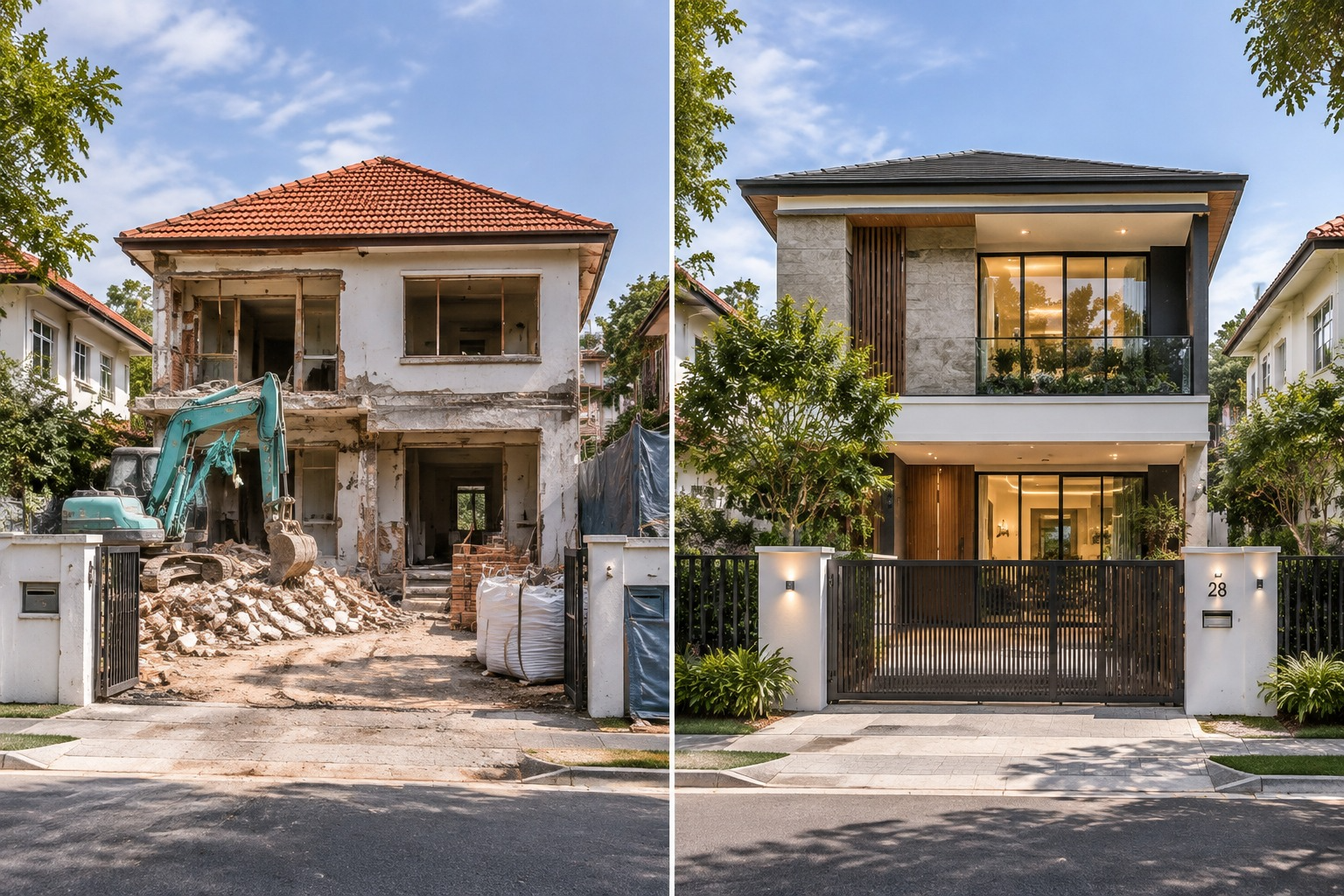
Owning a landed property in Singapore gives you something most homeowners never have: the ability to reshape the home entirely. Not just repaint or renovate, but pull it down and build exactly what you want on the land you already own. For many families, that option is the whole point of buying landed in the first place.
But deciding to rebuild a landed property in Singapore is not a simple project. URA rules, envelope control guidelines, Qualified Person requirements, permit approvals, demolition, construction timelines, and financing all need to be understood before any commitment is made. This guide covers the full process: from understanding what a rebuild actually involves, to costs, approvals, whether A&A might be enough, and how the decision affects your property's long-term value.
If you want a straight conversation about whether rebuilding makes financial sense for your specific property, the team at Colin Choo Property can walk you through the numbers — from current market value to post-rebuild expectations before you commit to anything.
What Does Rebuilding a Landed Property Mean in Singapore?
Not all works on a landed home are the same. Before deciding to rebuild, it helps to understand where your planned works actually sit because the approval process, cost, and timeline differ significantly depending on scope.
Additions and Alterations (A&A) cover works that do not change the home's existing structure significantly. Replacing flooring, hacking non-structural walls, adding a mezzanine floor, or installing a partition all fall under A&A. URA guidelines state that A&A works must not increase the gross floor area (GFA) by more than 50%. Some A&A works do not require planning permission; others do; it depends on what is being changed.
Reconstruction applies when proposed works exceed 50% of the GFA, involve replacing or adding external walls, require new structural beams or columns, or include adding a storey or replacing the roof. URA treats these as reconstruction regardless of the percentage of GFA change.
Full rebuilding means demolishing the existing structure entirely and constructing a new home from the ground up. This gives the owner the most design freedom within URA's development control guidelines and is typically chosen when the existing structure is too old or too constrained to be worth retaining.
Understanding which category your plans fall into matters because the approvals, costs, and timelines are different for each. A Qualified Person (QP), a licensed architect or professional engineer, can assess your property and confirm which route applies.
When Does It Make Sense to Rebuild a Landed Property in Singapore?
Rebuilding is not always the right answer. But there are situations where it is clearly the most sensible path.
- The existing structure is too old or structurally compromised: Extensive repairs may cost more than building new, and the result is still an old house. A full rebuild gives you a structurally sound, modern home that will hold its value over the long term.
- The land is being underutilised: A single-storey house on a large freehold plot in a mature estate is often not maximising the allowable GFA under URA's envelope control. Rebuilding allows you to develop to the full permitted size.
- The layout no longer fits the family's needs: Multi-generational living, a home lift, a basement, a pool, or a dedicated home office; these requirements often cannot be retrofitted through A&A alone.
- You purchased specifically to rebuild: Many buyers acquire older landed homes at a relative discount precisely because they intend to tear down and build to their own design. The existing house is a holding structure, not a home.
- A&A costs are approaching rebuild territory: When the scope of renovation work creeps past S$500,000 to S$800,000, the cost difference between a major A&A and a full rebuild narrows. A rebuild delivers a fully new structure for a comparable uplift in spend.
The right answer depends on your specific property: its condition, its plot size, its zoning, and your long-term plans. A property with genuine structural issues and a strong freehold land position is almost always a better rebuild candidate than a leasehold property with 40 years remaining.
URA Rules to Check Before You Rebuild
Singapore's Urban Redevelopment Authority (URA) sets the development control guidelines that determine what you can and cannot build on your landed plot. These are not optional, and they are not negotiable. Checking them early, before any design work begins, prevents expensive changes later.
Envelope Control Guidelines
URA's envelope control guidelines set the maximum allowable height and massing for each landed property. For two-storey zones, the maximum height is 12 metres. For three-storey zones, it is 15.5 metres. Attics are limited to a height of 3.5 metres.
Within the permitted envelope, owners have significant design freedom: varying ceiling heights, mezzanine floors, double-volume spaces. The envelope shape defines the outer boundary; what you do inside it is largely your choice. To check your property's zoning, use URA's Landed Housing Area Plan and search your address.
Plot Ratio and Site Coverage
Plot ratio controls the total floor area you are permitted to build. A plot ratio of 1.4 on a 2,000 sqft plot allows a maximum GFA of 2,800 sqft. Site coverage limits how much of the land area can be built upon, and varies by property type. Exceeding either will result in plans being rejected.
Setback and Boundary Requirements
Most landed property types require a front setback of 7.5 metres from the road. Side and rear setbacks vary by property type; typically 2 metres for most terrace and semi-detached homes. Roof eaves have separate boundary clearance requirements.
The Road Line Plan (RLP), available from LTA, shows any road reserves or planned road widening that may reduce your effective usable land area. Checking the RLP before designing is not optional; building too close to a future road reserve can invalidate plans.
Conservation Area Restrictions
If your property sits in a designated conservation area or heritage estate, URA imposes stricter design controls. Key heritage features must be preserved, and the scope of what can be rebuilt may be significantly limited. Always check with URA directly before assuming a full rebuild is possible in a conservation estate.
What Approvals Do You Need to Rebuild a Landed Property?
A full rebuild requires approvals from multiple authorities before any demolition or construction can begin. The process is structured and sequential; skipping steps or starting without approvals creates serious legal and financial risk.
- Engage a Qualified Person (QP). A QP is a licensed architect or professional engineer registered with BCA. They prepare, certify, and submit your building plans to the relevant authorities. You cannot submit plans without one.
- Submit plans to URA for planning approval. Your QP prepares detailed architectural drawings and submits them to URA for planning permission. This confirms that the proposed development complies with development control guidelines.
- Obtain BCA approval. The Building and Construction Authority reviews plans for structural safety. Your QP coordinates this submission alongside the URA application.
- PUB approval for sewerage and drainage. The Public Utilities Board must approve sewerage, drainage, and water works. Your QP purchases the Sewerage Information Plan (SIP) and ensures compliance.
- LTA clearance if road access is affected. If the rebuild impacts road access or the boundary near a road reserve, the Land Transport Authority must be consulted.
- Demolition permit. A separate permit is required before the existing structure can be demolished. Hazardous materials such as asbestos must be identified and removed safely before demolition proceeds.
- Temporary Occupation Permit (TOP) or Certificate of Statutory Completion (CSC). After construction is complete, your QP applies for TOP or CSC to certify that the new home is safe to occupy and meets all requirements.
The approval process from plan submission to receiving URA and BCA approval typically takes three to six months. Errors in submissions or incomplete applications extend this. Starting design work early, with an experienced QP who knows the process, significantly reduces delays.
How Much Does It Cost to Rebuild a Landed Property in Singapore?
Rebuilding is one of the largest financial commitments a landed property owner can make. Understanding the cost components upfront prevents surprises during the project.
| Cost Item | Estimated Range |
|---|---|
| Demolition | S$15,000 – S$40,000 |
| Construction (basic to mid-range) | S$350 – S$500 per sqft |
| Construction (high-end/luxury) | S$500 – S$800+ per sqft |
| Architect / QP / Engineering fees | 8–12% of total construction cost |
| Interior design | S$15,000 – S$50,000+ |
| Temporary accommodation (during rebuild) | Budget separately; typically 14–18 months |
| Contingency fund | 10–15% of total budget |
These are reference ranges; not fixed quotes. Final costs depend heavily on the size of the plot, the number of storeys, design complexity, material choices, and market conditions at the time of construction. Luxury features such as a basement, home lift, swimming pool, or smart home systems add significantly to the total.
On a standard 2,000 to 3,000 sqft landed plot, a full rebuild including professional fees and contingency typically falls in the range of S$800,000 to S$2.5 million. High-specification builds on larger plots can exceed this.
Always obtain at least two to three quotes from licensed contractors before committing to a budget. And factor in temporary accommodation costs; most families need to rent elsewhere for the full duration of the rebuild.
How Long Does a Landed Property Rebuild Take in Singapore?
Most homeowners underestimate how long a full rebuild takes. The construction phase is only part of the timeline. Planning, approvals, and final certifications all add months before and after.
- Design and planning: 2 to 4 months for architectural drawings, design iterations, and preparation of submission documents.
- URA and BCA approvals: 3 to 6 months. Complex or unusual designs, or properties in sensitive areas, can take longer.
- Demolition: 2 to 4 weeks, including hazardous material removal if required.
- Construction: 9 to 14 months for a standard landed rebuild. Larger or more complex projects run longer.
- TOP / CSC: 1 to 2 months after construction is completed.
Realistic total timeline: 14 to 20 months from the start of design to moving in. Some projects take longer due to contractor issues, material supply delays, design changes during construction, and revision requests from authorities, all of which extend the schedule. Build a realistic buffer into your planning.
If you are renting while the rebuild is underway, the rental period and associated costs need to be factored into the total financial picture, not just the construction budget.
Step-by-Step Process to Rebuild a Landed Property in Singapore
Here is the full sequence from initial assessment to moving into your new home.
- Assess the existing property. Understand its structural condition, remaining useful life, and whether A&A or reconstruction might achieve your goals at lower cost and in less time than a full rebuild.
- Check planning constraints. Confirm your URA zoning, envelope control limits, setback requirements, and Road Line Plan position before committing to any design direction.
- Set your budget and requirements. Define the total budget including construction, professional fees, temporary accommodation, interior design, and contingency. Decide on the number of storeys, key features, and timeline requirements.
- Engage a Qualified Person. Appoint a licensed architect or professional engineer to lead the design and approval process. Choose someone with experience in Singapore landed residential projects specifically.
- Develop architectural plans. Work with your architect to finalise the design within URA's envelope control and development control parameters.
- Obtain all required approvals. Submit to URA, BCA, PUB, and LTA as required. Wait for all approvals before proceeding. Do not begin demolition without written approval.
- Demolish the existing structure. Engage a licensed demolition contractor. Handle hazardous materials safely and comply with all permit requirements.
- Construction. Your appointed contractor builds to the approved plans. Schedule regular site inspections, especially before structural elements, plumbing, and electrical works are sealed.
- Final inspections and TOP / CSC. Your QP coordinates final inspections with BCA and applies for TOP or CSC to certify that the home meets all requirements.
- Handover and move in. Once TOP or CSC is obtained, the home is legally occupiable. Interior works, furniture, and landscaping are typically completed after this stage.
A&A vs Full Rebuild: Which Option Makes More Sense?
This is the question most landed property owners face before committing to a major project. A&A may be sufficient when the existing structure is sound, changes needed are moderate, and the budget is limited. A full rebuild makes more sense when the structure has significant age or issues, desired layout changes exceed what A&A permits, or the long-term plan is to hold for decades. The cost difference narrows once A&A scope reaches S$500,000 to S$800,000; at that level of spend, the additional cost of a full rebuild becomes harder to justify avoiding.
Tenure matters too. Investing S$1.5 million in rebuilding a freehold landed home makes different financial sense from doing the same on a leasehold property with 40 years remaining. An experienced landed property agent in Singapore can help you weigh both options against your property's actual market position before you commit to either.
Does Rebuilding Increase Your Landed Property's Value?
Yes; but not automatically, and not always in proportion to the cost of the rebuild. The location of the land and the characteristics of the plot are the primary value drivers. A new structure on a well-positioned freehold plot in a mature estate will command a strong market price. A new structure on a poorly positioned leasehold plot with a short remaining lease will not.
What a quality rebuild does deliver is a significantly expanded buyer pool. An old house on a good plot attracts developers and buyers with rebuild plans. A newly completed, well-designed home on the same plot attracts families who want to move in directly, a considerably larger pool of buyers at higher price points.
The risk of overcapitalising is real, particularly on smaller plots. Spending S$2 million on a rebuild on a 1,200 sqft plot in a non-prime estate may not recover that cost in the market value of the completed home. The rebuild decision should always be stress-tested against what the completed home is expected to sell for, not just what it will cost to build.
For a realistic assessment of post-rebuild market value for your specific plot and estate, speaking to an experienced property agent in Singapore who has handled landed transactions in your area gives you a more reliable number than any general estimate.
Should You Rebuild or Sell Your Landed Property?
For owners who are undecided between rebuilding and selling, the decision usually comes down to a few honest questions.
Do you want to stay in this location long-term? Rebuilding commits you to the same plot for at least the duration of the rebuild plus several years to justify the cost. If your preferences or needs may change family moving out, job relocation, lifestyle change, selling and buying a ready home in a different location may be the cleaner path.
Does the land justify the rebuild investment? A large freehold plot in a desirable estate is worth developing. A smaller or leasehold plot in a weaker location may be better sold, and the proceeds used toward a different property.
What is the total cost of rebuilding vs selling and upgrading? Factor in the rebuild cost, professional fees, temporary accommodation, and the time out of the home. Then compare this to selling the current property, paying transaction costs, and buying a ready-built or newer home. In some cases, the numbers favour selling; particularly where ABSD does not apply because the existing property will be sold first.
How much time and energy are you willing to invest? A rebuild is a 14 to 20 month project that requires active involvement and decision-making throughout. Some owners find this energising. Others find it exhausting. Be honest about which camp you fall into before committing.
A property consultant in Singapore who handles landed property can model both scenarios rebuild and stay vs. sell and upgrade with actual market numbers for your specific property. That comparison, done properly, makes the decision considerably clearer.
What to Check Before You Commit to a Rebuild
Before any agreement is signed with a contractor or architect, work through this checklist.
- URA zoning and envelope control: Confirm your maximum height, GFA, and site coverage allowances for the specific plot.
- Road Line Plan: Check whether any planned road widening affects your usable land area.
- Conservation area status: If your estate is a conservation area, confirm what URA permits before committing to a design scope.
- Property tenure: For leasehold properties, the remaining lease must justify the rebuild investment financially.
- Structural assessment: Have a qualified professional assess the existing structure. This confirms whether A&A is viable or whether a full rebuild is genuinely necessary.
- Contractor quotes: Obtain at least two to three quotes from licensed contractors before finalising a budget. Do not sign based on a single estimate.
- Financing: Confirm your funding source; construction loan, home equity, cash, or a combination. Speak to your bank about construction loan drawdown terms before committing to a construction start date.
- Temporary accommodation: Plan and budget for where you will live during the rebuild. A realistic rental budget for 14 to 18 months needs to be included in the total project cost.
Buying an Older Landed Property to Rebuild? What to Check First
Purchasing an older landed home with the intention of tearing it down and rebuilding is a legitimate and increasingly common strategy in Singapore. The existing house is priced lower, sometimes significantly, which can offset part of the rebuild cost. But the due diligence before exercising the OTP is more involved than a standard purchase.
- Do not judge by the existing building alone: The house will be demolished. What matters is the land; its shape, size, orientation, and what URA permits you to build on it.
- Check the envelope control parameters for the specific plot: Confirm the maximum height, GFA, setbacks, and site coverage before you assume the rebuild will deliver what you have in mind.
- Verify the Road Line Plan: A potential road widening that reduces the usable land area is a significant consideration when the entire investment rationale is the rebuild potential.
- Factor in the complete budget: Purchase price plus stamp duty plus total rebuild cost plus temporary accommodation. Run the full numbers before you offer, not after.
- Engage a QP for a preliminary assessment before the OTP: An architect can quickly assess whether the plot parameters match your intended design and flag any constraints before you are legally committed.
- For leasehold properties: Confirm the remaining lease and CPF usage restrictions. Rebuilding a leasehold home with 50 years remaining is a different financial proposition from a freehold plot.
How a Property Agent Can Help With Your Rebuild Decision
Most of the decisions around a landed property rebuild are financial ones, and many of them are better informed by market data than by construction estimates. An experienced property agent in Singapore who actively works in the landed segment brings a perspective that architects and contractors cannot: what the completed home will actually be worth in the current market.
Before committing to a rebuild, a good agent can help you:
- Compare the expected post-rebuild market value against the total cost of rebuilding, including construction, professional fees, and temporary accommodation
- Assess recent landed transaction prices in your estate to establish a realistic ceiling for the rebuilt home's value
- Model the alternative: selling the existing property and purchasing a newer or already-rebuilt home, with real numbers rather than assumptions
- Connect the rebuild decision to your broader property plans, including whether the rebuilt home fits your long-term goals or whether a different property type or location serves you better
The rebuild decision and the property market decision are not separate. Getting both right requires someone who understands both.
Talk to Colin Choo Before You Decide
A landed property rebuild is one of the few property decisions where getting the financial logic right matters as much as getting the design right. The construction side has architects and contractors. The market side: what the land is worth, what the completed home will sell for, and whether rebuilding or selling makes more financial sense for your specific situation; is where Colin Choo Property brings genuine value.
With close to 1,000 transactions across HDB selling, condo buying, and landed property in Singapore over 14 years, including specific experience with landed property sales, upgrades, and acquisition, the conversation starts with your property's actual market position, not with a generic rebuild checklist.
Whether you own an older landed home and are weighing whether to rebuild or sell, or you are considering buying a property specifically for its rebuild potential, WhatsApp Colin Choo at Colin Choo Property first. The numbers will tell you which direction makes sense.
FAQs
1. What is the difference between A&A and rebuilding a landed property in Singapore?
+
A&A covers works that do not increase GFA by more than 50% without significantly altering the structure. Rebuilding means demolishing the home entirely and starting from scratch. Reconstruction sits in between; structural changes exceeding 50% GFA but stopping short of full demolition.
2. Do I need URA approval to rebuild a landed property?
+
Yes. A full rebuild requires URA planning approval, BCA structural approval, PUB sewerage approval, and a demolition permit before works begin. A Qualified Person: a licensed architect or engineer; manages all submissions on your behalf.
3. How much does it cost to rebuild a landed property in Singapore?
+
Construction costs typically range from S$350 to S$500 per sqft for standard builds and S$500 to S$800+ for high-specification projects. Add demolition, professional fees, interior design, temporary accommodation, and a 10–15% contingency. Most standard rebuilds fall between S$800,000 and S$2.5 million.
4. How long does a landed property rebuild take in Singapore?
+
Realistically, 14 to 20 months from design to move-in, including approvals, demolition, construction, and TOP or CSC. Budget for temporary accommodation for the full duration.
5. Can I live in my property while it is being rebuilt?
+
No. The existing structure is demolished entirely. Most rebuilds take 14 to 18 months from demolition to handover; arrange and budget for alternative accommodation before committing.
6. Does rebuilding a landed property increase its value in Singapore?
+
Generally yes; but not always in proportion to the rebuild cost. Location and land characteristics drive value more than the new structure alone. Overcapitalising on smaller or less well-positioned plots is a real risk.
7. Should I rebuild or sell my landed property?
+
Rebuilding makes more sense when you want to stay long-term on a freehold, well-positioned plot. Selling makes more sense when your needs may change or when buying a newer ready home delivers a comparable outcome with less time and cost.
8. Can a semi-detached house be rebuilt in Singapore?
+
Yes, subject to URA development control guidelines, envelope control parameters, and BCA structural requirements. A Qualified Person must manage the approval process.